


 NORTHKOALA:

-
- Mağaza Tasarımı
- ARÇELİK Mağaza
- Arçelik Mağaza
- Shangri la mall Sri
- womens clothing
- Konsept Dükkan
- BEKO Mağaza Tasarımı
- Vestel Store
- Coffe shop interior
- 3D showroom home
- Bookstore 3D Design
- Kaduwella Singer
- Vestel Store Design
- Mağaza Tasarımı
- Showroom Tasarımı
- Showroom Tasarımı
- SINGER Mega
- Showroom Tasarımı

Famous Quotes
Project Detail
Share:





African savanna about and animals
African savanna


Savannas are dominated by grasslands, with trees scattered only sporadically across the land. A savanna has two main seasons, wet and dry. Since the dry season is long, animals have learned to adapt to stay alive, keeping the ecosystem in balance. Savannas exist in areas such as Australia, South America and Africa. However, Africa contains the richest diversity of animals, notes the Blue Planet Biomes website.
Ungulates of the Savanna
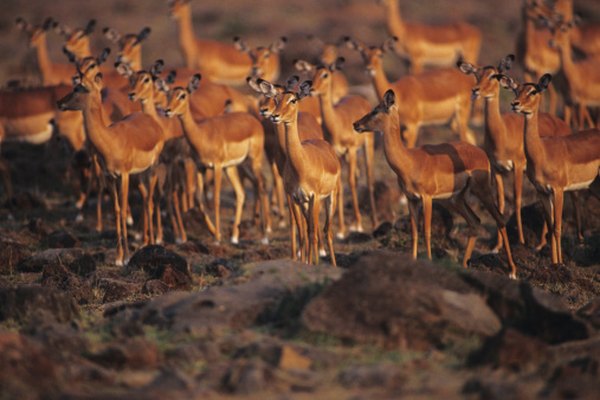 •••Ungulates are hoofed animals, some of them found in the savannas of the world. These types of animals have long legs and hooves that help the animal run and bound in an effort to escape predators. The impala can leap 10 feet into the air and can bound a distance of nearly 33 feet, notes National Geographic. Impalas, which are a type of antelope, can gather in the hundreds to offer protection against potential predators. Mating can be exhausting for males, since they must battle against rival males. Those who lose retreat to a herd of bachelor males.
The wildebeest or gnu, is a type of large antelope. Wildebeest follow an instinctual migration in search of food. The migration can include more than one million wildebeest, as well as zebra and gazelles who migrate with the wildebeests. This great migration will occur after the birth of calves, between January and February. So great is their urge to migrate, that many calves are lost through the process.
VIDEO OF THE DAY
Savanna Cats
 •••Lions live within prides. While a male will leave his pride and develop his own family unit, females stay within their birth family unit. Lions engage in communal hunting, but more than 50 percent of what they eat comes from scavenged food, according to the African Wildlife Foundation. Males will fiercely defend their family, even chasing off other males.
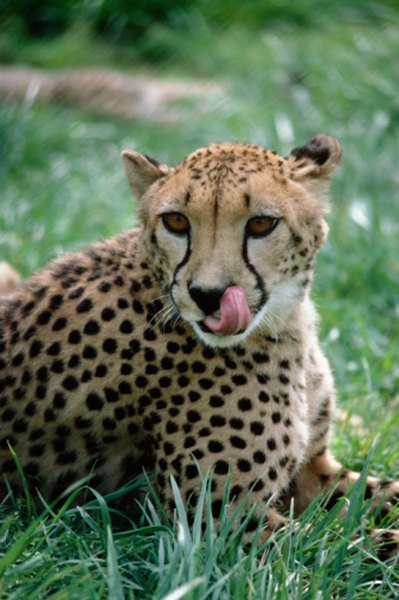
Cheetahs can clock in at 60 miles per hour in three seconds. If a cheetah is successful at catching up with its prey, the cat will swipe the animal down and deliver a death bite to the neck. Cheetahs must eat quickly to avoid their food being stolen by more aggressive animals, such as hyenas and lions. Female cheetahs protect their young by hiding their cubs in new dens every three days. Animals such as hyenas prey on young cheetah cubs, and many cubs might not live beyond three months.
Snakes in the Savanna
In the African savanna many deadly snakes exist, including the world's most lethal, the black mamba. A human can die within 20 minutes of being bitten by a black mamba. The black mamba is an aggressive snake and will strike without provocation. While an antivenin exists for the black mamba, it is not widely available, making death imminent after being bitten for a person who is not treated.While the African rock python is not poisonous, it is capable of killing prey as large as an antelope. The teeth on the African rock python help it to catch prey in its jaws, holding onto it as the snake constricts tightly around the animal. Because an African rock python is capable of catching large prey, it can go nearly a year without eating another meal.
Other Savanna Dwellers
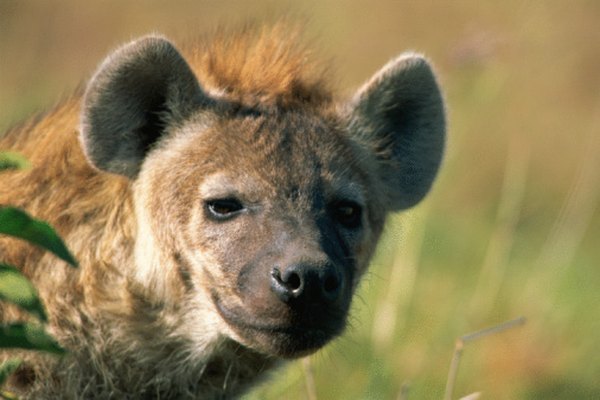 •••Hyenas live in clans, with females being dominant over the males. Females are larger than males and are more naturally aggressive. Females hyenas may have adapted to become larger as a way of protecting their young from cannibalistic males. Hyenas will eat almost every part of the animal, with the exception of hair and hooves.
The African wild dog lives in tight packs, which are run by an alpha pair consisting of a dominant male and female. Unlike other canines, the African wild dog has four toes per foot. African wild dogs are fierce predators, and when working in a pack, will pursue their prey for more than an hour.
Meerkats are a type of mongoose, known for standing on their hind legs. Female meerkats can even nurse their young on their hind quarters. These animals live in large communities known as mobs, and both males and females care for their young. Even though meerkats live in burrows, they usually live in burrows dug by other animals, such as ground squirrels.
References
Photo Credits
CITE THIS ARTICLEDid you find this page helpful?👍👎
Species
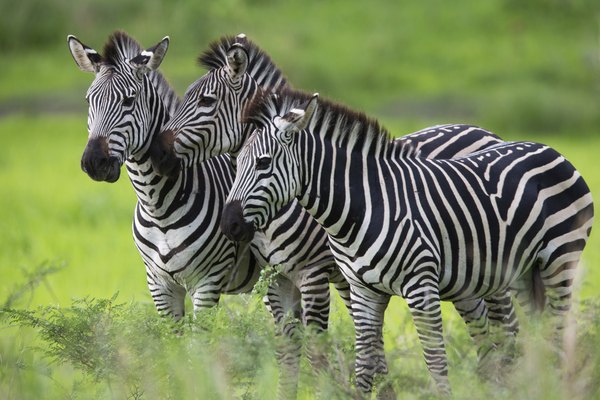 •••There are three species of zebra in Africa. The most populous is the plains, or Burchell's, zebra. The other two species are Grevy's, which is named for an 1880s French president who received one of the zebras as a gift, and the mountain zebra. The Grevy's zebra now competes with livestock for water resources as agricultural land has taken over much of its natural habitat. According to the African Wildlife Foundation, the Grevy's zebras now number approximately 2,500; a few decades ago 15,000 of them existed.
Population Location
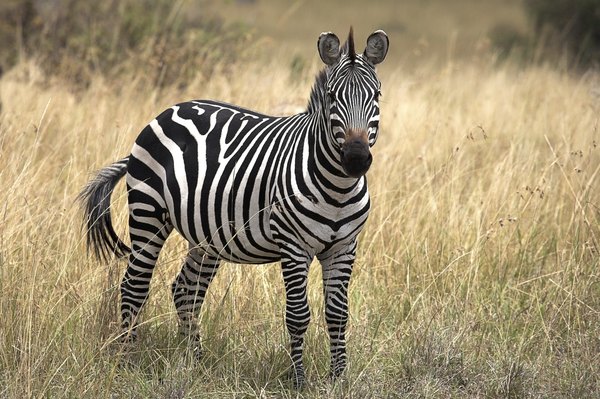 •••Burchell's zebras inhabit savannas in East Africa, in a variety of landscapes from grasslands to woodlands. Grevy's are mostly found now only in Northern Kenya. The mountain zebra lives in Southern and Southwestern Africa.
Physical Characteristics and Lifespan
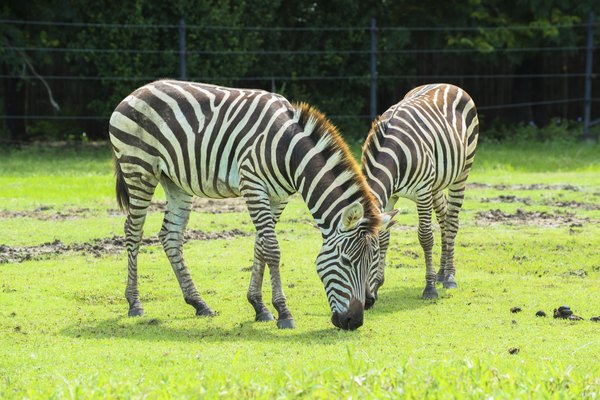 •••Zebras are plant eaters, and can live up to 40 years in captivity. Grevy's zebras are taller and heavier than their Burchell's counterparts: A Grevy's zebra can be as tall as 50 to 60 inches at the shoulder and weigh between 770 and 990 lbs. Burchell's are about 45 to 55 inches high and weigh between 485 and 550 lbs. The mountain zebra is built like a donkey and has an extra flap of skin on its throat. All zebras' stripes form a camouflage that makes them seem further away or difficult to see at times of day when predators are most active.
Communal Behavior
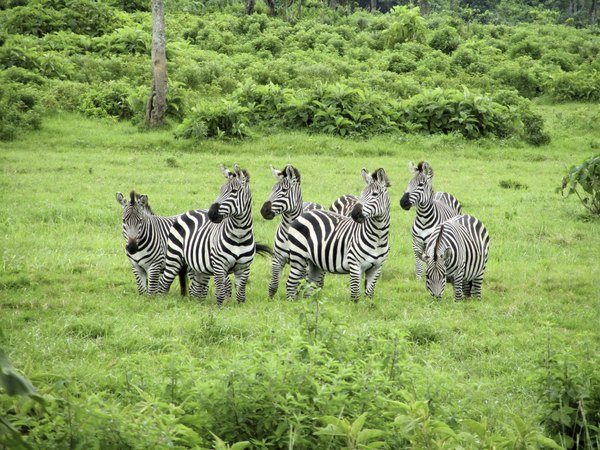 •••Burchell's zebras roam in organized social groups led by a stallion, which cares for a small group of mares and their foals. The mares remain together even after the stallion dies and is replaced by another. Males form bonds with other males and very large groups will migrate together, led by the oldest females, to find new sources of grass and water. The Grevy's zebras are, instead, solitary and claim territory and mate with the females whom they encounter within that territory.
References
About the Author
Photo Credits
Gestation and Birth
Lion cubs gestate for approximately 110 days and are born in a litter of between one and six babies, although two to three cubs at a time is considered normal by the Predator Conservation Trust. These cats are born helpless and blind away from their pride, as their mothers typically leave to give birth in a safe place shortly before. The mother and cubs stay in isolation for four to eight weeks.Risks Away From the Pride
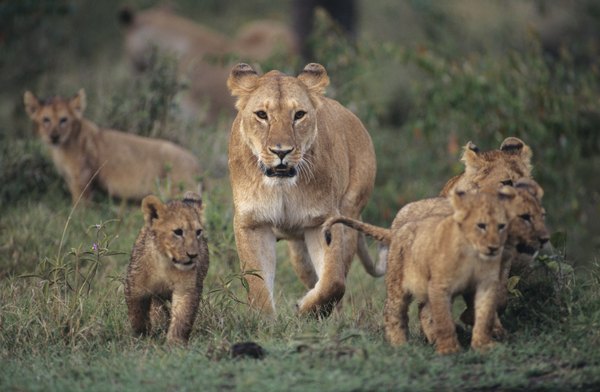 •••Young cubs are vulnerable to various predators, including hyenas, leopards, jackals, pythons and martial eagles. The mother acts as protector by finding the safest hiding places she can, picking up each cub in her mouth one by one to move them. She must hunt during this time to maintain her health and milk supply, so there are times the cubs will be left alone.
Risks From the Pride Itself
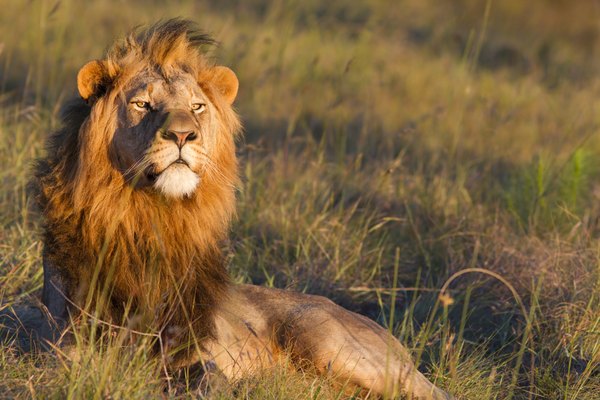 •••African lions live in prides of between one and three males, along with several females and their cubs, while male lions in India live apart from females and their cubs. When new cubs are introduced to an African pride, the mother makes clear her intentions to protect them from both male and female pride members. While other females can be aggressive toward the cubs, males are more likely to be a threat. One of the greatest dangers to baby lions is new dominant males who have taken over the pride. If the mother returns from birthing and early rearing to a shift in male power, the newly instated dominant males will kill her cubs. If this shift were to occur later on, but before the young ones were old enough to outrun the males, they will be killed then as well.
Pride Relatives
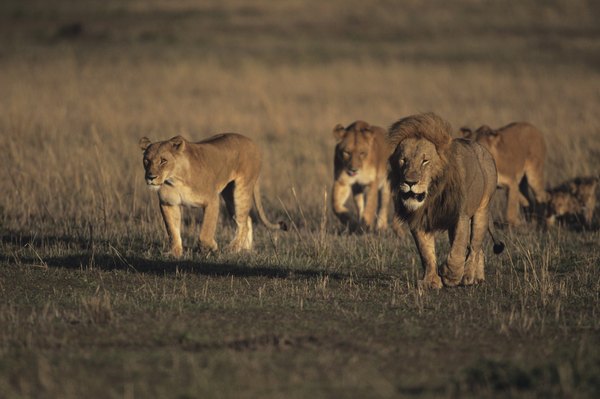 •••All cubs in the pride are related to the other cubs and other members of the pride in some way. Females are almost always related to one another and the cubs are usually offspring of between one and three dominant males. Females will often nurse each others' cubs and defend them against threats. Eventually, males will leave the pride, while most of the females will stay with the family group.
Eating Habits
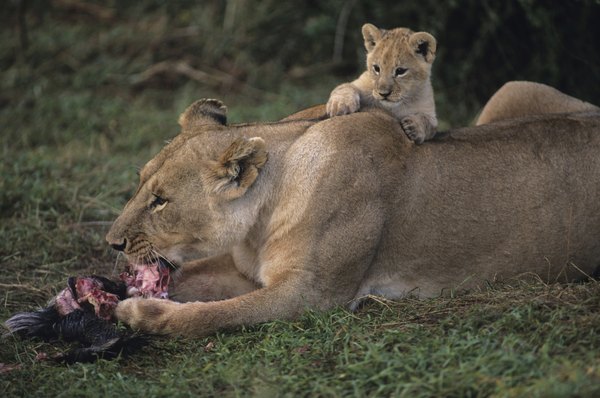 •••Lion cubs nurse for approximately six months, but will begin eating meat at three months. They will nurse at any vacant teat--including at a teat that is not their mother's if the other female will allow it--unlike leopard cubs, which nurse from the same teat on the same mother every time. Baby lions get the last pickings from a kill and do not begin to hunt for themselves until they reach one year of age. Due to threats from starvation, predators and male lions, up to 80 percent of baby lions die within the first two years.
References
About the Author
Photo Credits
Global booth design
-


Booth Expo Design
Umay Tech Exhibition Booth Design


-


Booth Expo Design
Natural Enerji Exhibition Booth Design
-


Booth Expo Design
Ülker Exhibition Stand Design
-


Booth Expo Design
Exhibition / Fair Stand Design / PANDA London
-
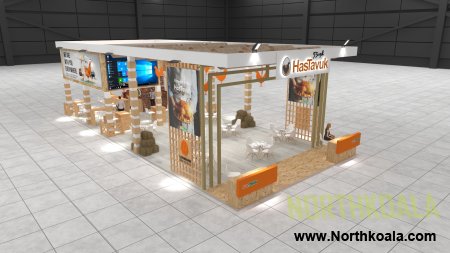
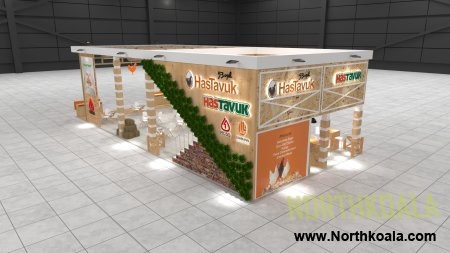
Booth Expo Design
Fair Stand Design
-


Booth Expo Design
Creative stand design for ceramics fair
Showroom Design
-


Showroom Design
Lanka Tiles Palawatte Showroom Design
-


Showroom Design
Arçelik Mağaza Tasarımı
-


Showroom Design
Singer Mega Nugegoda Showroom 2022 New Design
-


Showroom Design
ROCELL Stone Showroom Concept Design
-


Showroom Design
Lanka Tiles Showroom 2022 New Concept Design
-


Showroom Design
Hotel Restourant VIP concept interior design
Other news
News >- Umay Tech Exhibition Booth Design
- Natural Enerji Exhibition Booth Design
- Ülker Exhibition Stand Design
- Exhibition / Fair Stand Design / PANDA London
- Fair Stand Design
- Creative stand design for ceramics fair
- Modern and Elegant Exhibition Stand Design for a Leading Food Company
- Advanced Communication Technology Stand Design
- Explore the Underwater Wonders of Türkiye: Dive into the Experience
- Cosmolive's Natural and Modern Appeal
- Sleek and Contemporary Stand Design
- Striking Elegance: A Modern Trade Show Stand Design
- Innovative Exhibition Stands Reflecting the Future of Technology
- Modern and Elegant Exhibition Stand for Quartz Surfaces
- Innovative Exhibition Stand Design for a Small Machinery Manufacturing Company


Do Not Wait, Contact with us now.